
Reviewed · HISTORICAL TOURS
Tirana Walking Tour around the Historic Centre
Tirana’s historic centre packs a lot into a short walk. You get a smart mix of major landmarks plus real context, from Skanderbeg Square to communist memory sites. I especially like the inside access to key places of worship, and the way the route keeps snapping back to Albania’s identity through monuments. One thing to plan for, this is a fast-moving highlights walk, so if you want long museum time, you’ll need to slow down later on your own.
This tour is priced low for what you cover, and it stays practical. Expect quick stops, photo pauses at famous statues, and enough background to help you read Tirana instead of just passing it by. The group size is capped at 20, so you’ll usually have the attention of an experienced guide without feeling lost in a huge crowd.
If you’re visiting Tirana for the first time, this is a strong way to get your bearings fast. You can then decide what deserves a second visit, whether that’s more churches, more art spaces, or a deeper look at the communist past.
In This Review
- Key moments that make this Tirana walk worth it
- Getting oriented fast in Skanderbeg’s Tirana
- National History Museum: Albania’s timeline, in one building
- Skanderbeg Square and the national hero monument
- Opera House area: performance culture in the centre
- Et’hem Bey Mosque: one of the most authentic stops
- Clock Tower of Tirana: a 19th-century time marker
- Reja, The Cloud: modern art with a light touch
- Bunk’Art 2: remembering the underground
- Rruga Murat Toptani: a pedestrian lane with Ottoman-era roots
- Fortress of Justinian: Byzantine walls under today’s city
- Saint Paul Cathedral: modern form, notable symbols
- Enver Hoxha Pyramid: the communist relic turned new purpose
- Boulevard of the Martyrs: government power and formal buildings
- Blloku: from party elite to nightlife address
- Rinia Park, Youth Park: a communist-era green break
- Orthodox Resurrection Cathedral: go inside the biggest Eastern Orthodox space
- Museum of Secret Surveillance, House of Leaves: the heavy end of the walk
- Value for $18.06: what you really get
- Should you book this Tirana historic centre walking tour?
Key moments that make this Tirana walk worth it
- Et’hem Bey Mosque, with an authentic inside visit and old fresco details you can actually see
- A real pyramid viewpoint, with a climb to the top for sunset photo opportunities
- Communist-era memory sites like Bunk’Art 2 and the Museum of Secret Surveillance, even if some viewing is exterior
- A faith-and-power mix you can walk between, from a Roman Catholic cathedral to a major Orthodox church
- The “layers” feeling of Tirana, where Ottoman, Byzantine, communist, and modern culture all show up close together
- Photo-stop structure at monuments, so you don’t waste time figuring out where to stand
More Walking Tours in Tirana

Getting oriented fast in Skanderbeg’s Tirana
The tour starts in the centre, near Karuseli, and it’s designed to move you outward from the core. You’ll walk through some of the most recognizable names in Albanian history, and the guide gives you the shortcuts to understanding why they matter.
A big plus here is that Tirana can feel a little confusing at first, wide roads and newer buildings mixed with older cores. This route gives you anchor points. Once you can name Skanderbeg Square and link it to the surrounding landmarks, the rest of the city makes more sense, even if you’ve never been before.
National History Museum: Albania’s timeline, in one building
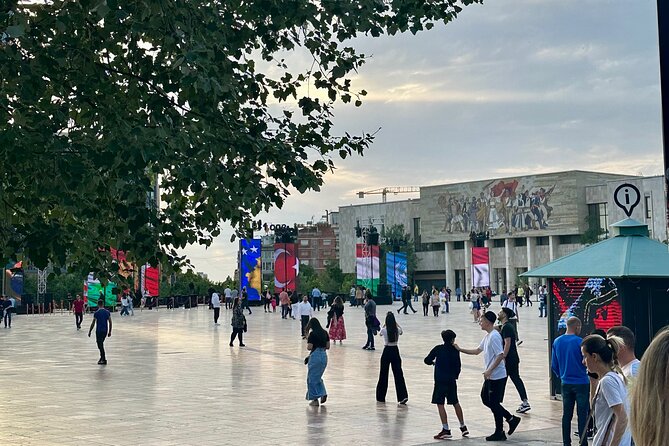
Your first stop is Muzeu Historik Kombetar, the National History Museum. It opened on 28 October 1981 and covers a large footprint, 27,000 square metres overall, with 18,000 square metres devoted to exhibitions. Above the entrance, there’s a big mosaic mural called The Albanians, featuring figures that stretch from ancient times to more modern history.
This is a useful start because it frames the rest of the walk. You’re not just chasing pretty sights, you’re setting up the big story behind the monuments you’ll see later. The time here is short, so treat it as a launch pad, not a full museum day. If you love museums, you may come back later and spend real time inside.
Skanderbeg Square and the national hero monument
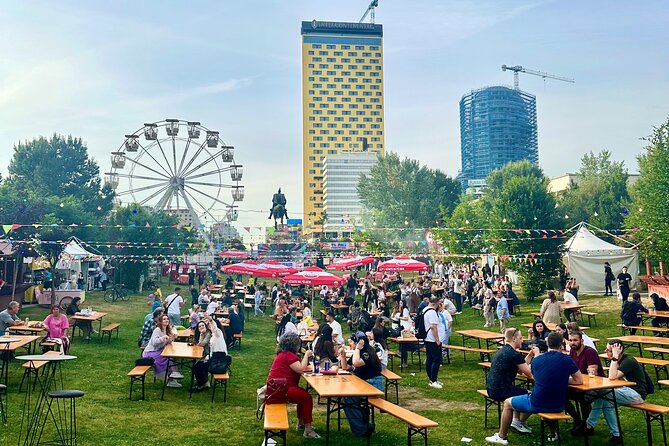
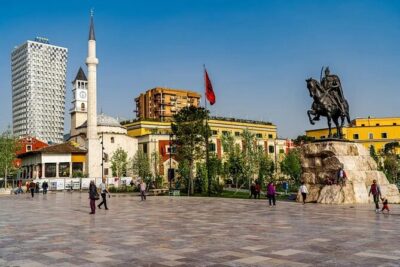
Next comes Skanderbeg Square, Tirana’s main plaza. It’s huge, around 40,000 square metres, and it’s dominated by the Skanderbeg Monument. The square is named after Gjergj Kastrioti Skënderbeu, Albania’s national hero known for resisting the Ottomans.
This stop matters because it’s a public statement in stone. You’ll see how Tirana uses space and symbols to keep national identity visible in daily life. It’s also a practical reset point in the walk, you pause, take photos, and get ready for the cultural stops nearby.
Opera House area: performance culture in the centre
The National Theatre of Opera and Ballet of Albania is the next highlight zone. It’s the largest theatre in the country and hosts music and dance performances year-round.
Even if you only see it briefly from the outside, it’s a reminder that Tirana is not stuck in the past. The guide’s context can help you connect this to Albania’s post-communist cultural growth. If there’s a performance during your dates, this stop can turn into a meaningful follow-up.
Not sold yet? More of Tirana to sift through:
- From Tirana: Bovilla Lake & Gamti Mountain Hiking Day Trip
★ 4.9 · 4,397 reviews - From Tirana: Bovilla Lake & Gamti Mountain Hiking Tour
★ 4.9 · 3,003 reviews - From Tirana: Bovilla Lake & Gamti Mountain Viewpoint Hike
★ 4.8 · 2,053 reviews - Tirana/Durres/Golem: Saranda, Ksamil, Blue Eye Day Trip
★ 4.8 · 1,584 reviews
Et’hem Bey Mosque: one of the most authentic stops
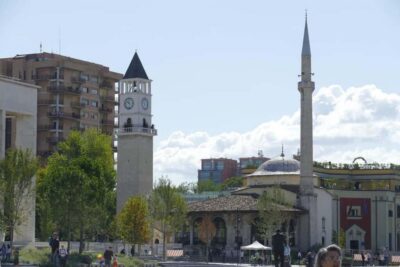
Now you shift into Ottoman-era religion with the Et’hem Bey Mosque. After being closed under communist rule, the mosque reopened as a house of worship in 1991. One of the standout details is the fresco artwork, with trees, waterfalls, and bridges, visible both outside and inside the portico area.
You’ll visit inside, and that’s the difference between seeing architecture and understanding it. Inside access is included, and it’s the kind of stop that changes how you remember a city. Watch for how the space feels, and how the artwork tries to bring nature into a sacred setting.
A good consideration: churches and mosques can have rules about dress and behavior, and you should plan to respect them even if you’re just there for a short visit. Wear something comfortable enough that you can adjust quickly.
Clock Tower of Tirana: a 19th-century time marker
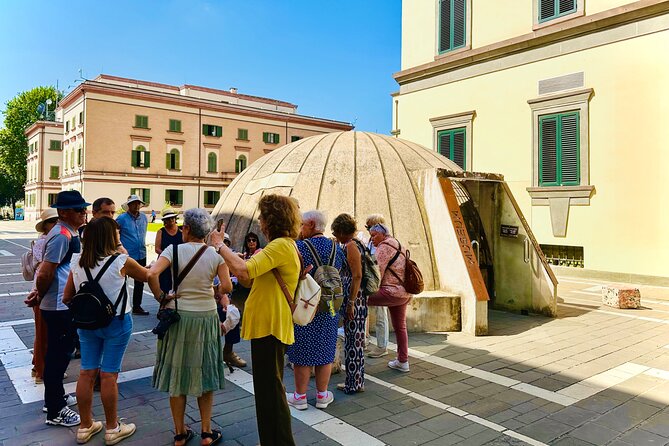
The Clock Tower is next, built in 1822 by Et’hem bey Mollaj. The watch mechanism was assembled by Ismail Tufina, and the tower is considered a first category monument of culture, approved on 24 May 1948.
This stop is quick, but it’s a great one for your “how did the city form” thinking. Small structures like towers can be more useful than grand buildings when you’re trying to understand urban development. They show you who paid attention to public life, not just power.
Reja, The Cloud: modern art with a light touch
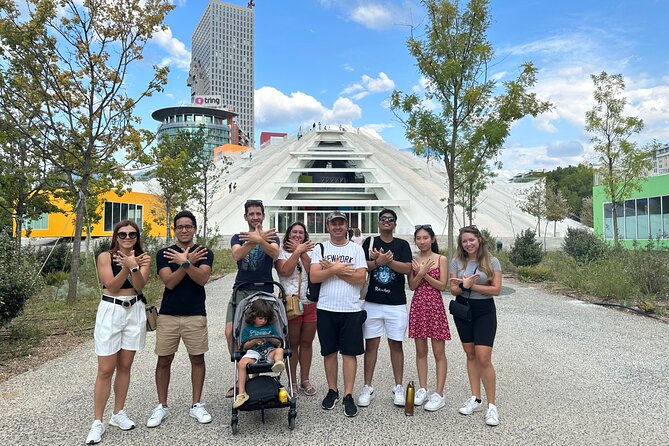
Reja, The Cloud is an art installation in front of the National Gallery of Arts. Since 2016, it has worked as a modern art space for cultural events in Tirana. The pavilion is delicate and three-dimensional, designed by Japanese architect Sou Fujimoto.
It’s only a few minutes on the route, but it’s a nice breath after the weightier history stops. This is where you see Tirana trying something different, making room for contemporary creative spaces in the centre. If you’re a design fan, you may want to circle back later to observe how the pavilion changes as you move around it.
Bunk’Art 2: remembering the underground
Bunk’Art 2 is built around a re-imagined communist-era nuclear bunker. The idea is to use art and storytelling to celebrate the birth of a new era while still remembering the solemn past. In this tour, you do an outside visit.
Outside viewing is still valuable. It gives you the scale and the setting, so when you later think about the bunker inside, you have a mental picture. If you’re interested in 20th-century history, consider adding extra time on another day, because the inside is where the full emotional impact usually lands.
Rruga Murat Toptani: a pedestrian lane with Ottoman-era roots
You then walk through Rruga Murat Toptani, a popular pedestrian street named for the Toptani family, a leading Albanian noble family during Ottoman rule. This is a break from heavy symbolism, and it’s also a chance to reset your pace.
Use this segment to notice how Tirana’s centre feels at street level. Small streets like this are where the city shifts from “monument tour” into “real life.” If you want a snack break later, this area is the kind of place where it’s easy to find something nearby.
Fortress of Justinian: Byzantine walls under today’s city
The Fortress of Justinian, also known as Tirana Castle, goes way back. Its history dates before 1300 and connects to the Byzantine-era. The fortress is described as the place where the main east-west and north-south roads crossed, making it a heart of Tirana. Inside the fortified walls, there are buildings you can visit, including restaurants, hotels, and cultural institutions.
Even if you only get a quick stop, it’s a powerful contrast point. You’re standing on the idea of Tirana’s earlier urban center, and now the city has grown around it. This is the kind of stop that helps you understand why Tirana is shaped the way it is, streets and movement patterns inherited from older eras.
Saint Paul Cathedral: modern form, notable symbols
Saint Paul Cathedral is a Roman Catholic cathedral in the Archdiocese of Tiranë-Durrës. The stained glass window to the left of the front door features Pope John Paul II and Mother Teresa, and there’s also a Mother Teresa statue at the entrance. The building is modern-looking, and it does not resemble a traditional church.
This is worth noting because first impressions matter. If you expect a classic old-world church facade, you might be surprised. But the symbolism still counts. It shows how Tirana’s religious identity is connected to international Catholic figures, and it’s a sign of how the city’s cultural networks widened over time.
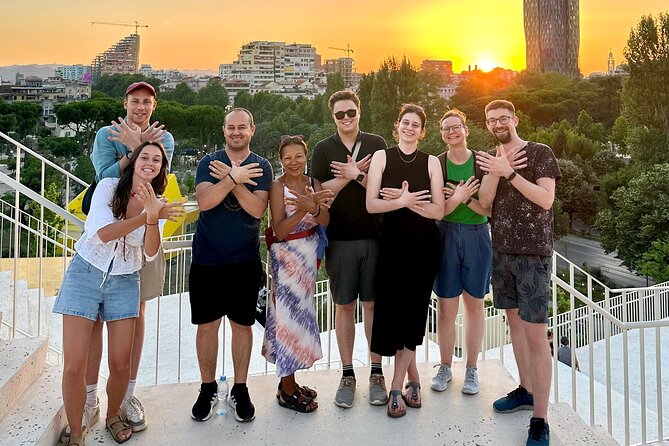
Enver Hoxha Pyramid: the communist relic turned new purpose
Next comes Enver Hoxha Pyramid, a structure and former museum of the dictator Enver Hoxha. It opened as a museum in 1988, then became a conference center in 1991 after the collapse of Communism. During the 1999 Kosovo War, it was used as a NATO base. In 2018, there was a project to turn it into a youth IT center with a focus on programming, robotics, and startups, under the name TUMO Center Tirana. The renovated structure was opened to the public in May 2023.
This stop is where Tirana’s history gets complicated fast. The pyramid is a perfect example of how post-communist cities repurpose heavy objects instead of erasing them. You’re seeing a literal transformation, and the guide’s explanation helps you connect the dots.
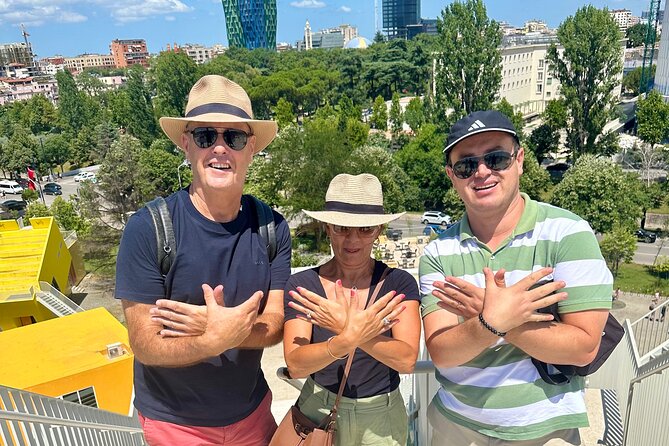
The tour also includes climbing up the top of the pyramid for breathtaking views, with a sunset view photo stop. That viewpoint is often the reason to book this specific walk, because it turns a political monument into a panorama. If you can time it for the right light, you’ll feel the city spread out under you.
Boulevard of the Martyrs: government power and formal buildings
Dëshmorët e Kombit Boulevard is a major thoroughfare lined with important buildings. Along it you have the Presidential Palace, the Prime Minister’s Office, the Palace of Congress, the Rogner Hotel, and the University of Tirana.
This isn’t just a drive-by street. It helps you understand how Tirana organizes its public authority and institutions. Even a short stop can show you a lot about the city’s modern political layout, and it links your walk back to how Tirana presents itself as a functioning capital.
Blloku: from party elite to nightlife address
Blloku is Tirana’s most famous neighbourhood. It’s leafy and residential, but today it’s also a hotspot for nightlife and shopping. You’ll find hip bars and cafes, plus trendy global restaurants alongside luxury boutiques.
During communist rule, it was a closed-off precinct for the party elite, and the villa of Enver Hoxha still stands. That’s the key contrast. Blloku isn’t just where people hang out, it’s where you can feel the shift from restricted power to public lifestyle.
If you want to turn your tour into evening plans, this is the area to remember. After the walk, you’ll be well-positioned for a meal without backtracking across the centre.
Rinia Park, Youth Park: a communist-era green break
Rinia Park, also called Youth Park, is Tirana’s central public park. It was built in 1950 during the communist era and covers about 2.98 hectares, or 7.4 acres. The park is also called Taiwan Park.
This stop gives you a pause from monuments and architecture. Parks matter when you’re walking for hours, and this one is centrally located. Even a short break here can help you keep your energy for the last cultural stops.
Orthodox Resurrection Cathedral: go inside the biggest Eastern Orthodox space
The Orthodox Autocephalous Church of Albania, the Resurrection Cathedral, is one of the largest Eastern Orthodox churches in the Balkans. The tour includes visiting the church from inside.
This is a big finishing cultural note. You’ve already seen a Roman Catholic cathedral, and now you get the scale and feel of an Orthodox space. Inside visits are a major value add, because the atmosphere, icons, and architecture details tend to be why people remember the place, not just the exterior.
A practical consideration: since this is an inside visit, plan for time and respectful behavior. If you’re taking photos, do it carefully and follow any guidance you receive at the door.
Museum of Secret Surveillance, House of Leaves: the heavy end of the walk
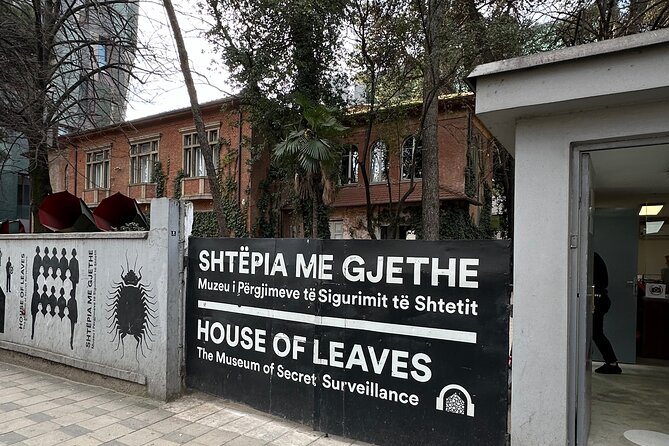
The final stop is the Museum of Secret Surveillance, also known as House of Leaves. It opened on 23 May 2017 and is housed in what served as Sigurimi headquarters during the communist era. The museum is dedicated to the innocent people who were spied on, arrested, prosecuted, convicted, and executed during the communist regime.
In this tour, you get an outside visit, and it’s noted as the best place to end because you can enter the museum at that point. Ending here makes sense, the emotional tone suits a wrap-up moment, not an early stop when your brain is still catching up.
If the topic is heavy for you, that’s okay. You can use the exterior orientation from the tour, then decide how long you want to spend inside.
Value for $18.06: what you really get
At $18.06 per person for about 2 hours and 30 minutes, the pricing is competitive for a guided walking tour that includes experienced certified guides and meaningful site access. Most of the stops have free admission listed, and the big value is how the guide connects the dots between the places.
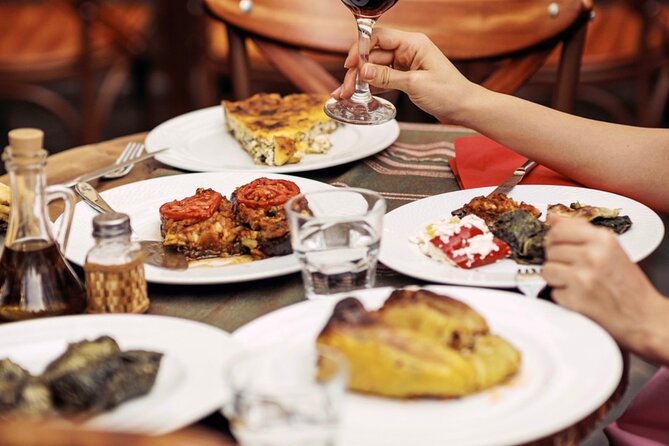
You also get built-in structure: photo stops at monuments, tips about traditional restaurants and dietary needs, and included entrance to churches and mosques. That last part is important, because a lot of city walks only point from the sidewalk.
Group size is capped at 20, and it’s offered in English. You also receive a mobile ticket. Those small logistics pieces matter because they make it easier to show up, check in, and stay focused on the sites.
One more thing: since it’s a highlights-style route with many short stops, bring walking shoes and plan to do a little follow-up research later. You’ll likely spot a couple of places you want to spend more time on after you get context.
Should you book this Tirana historic centre walking tour?
Yes, if you want a smart first walk through Tirana that gives you context, not just a checklist. This route is especially good for you if you care about how Tirana layers history into daily life, from Skanderbeg Square to communist memory sites.
I’d skip or modify it if you’re the type who wants deep time in a museum. This is designed for breadth in 2.5 hours, and some stops are outside visits with short orientation time. In that case, you can still book it, then plan a second outing to your top one or two sites.
One final practical note from what’s been shared publicly about the operator’s process: there has been at least one last-minute cancellation handled with a full refund due to an emergency. That’s not something you should bank on, but it does suggest they take basic customer fairness seriously.
If you want an efficient, meaningful start to Tirana, this tour is a solid bet. You’ll finish with a clearer mental map, stronger context for what you see next, and options for a great meal nearby.
A Few More History Tours in Tirana
Added to Tirana lately
- Kosovo, Prizren Day Trip from Tirana★ 3.0 · 1 review
- Semi-Private Hiking Tour; Theth,Valbona&Koman Lake in 3 Days★ 5.0 · 1 review
- Private 1 Day Berat Tour from Tirana★ 5.0 · 1 review
- Private 3 Days Adventure in Albania and Gjirokaster County★ 5.0 · 1 review
- From Tirana: Ksamil Islands, Saranda, & Blue Eye Day Trip★ 5.0 · 1 review
- Tirana Airport Private Transfer To City★ 5.0 · 1 review
- Architectural Walking Tour Discovering Tirana’s Modern Identity★ 5.0 · 1 review
- From Shkoder: 3-Day Valbona to Theth Hike Tour All Inclusive★ 5.0 · 1 review
Historical Tours, compared.
Guided tour in Tirana – discoveries, history, culture (in FRENCH)
Read our review →
Durres city & Golem beach, Sun & History Day Trip
Read our review →
Tirana Walking Tour: History, Culture &Gems by a Passionate Guide
Read our review →
Semi – Private Tour at Cape of Rodon; Hidden Beaches & History
Read our review →
Ancient City of Butrint, UNESCO World Heritage site – A Must
Read our review →Browse the lists this tour appears in