
Reviewed · SARANDA TOURS & EXPERIENCES
Old Religious Sites in the Sorroundings of Saranda
Five stops, three faiths, one quiet lesson. In about 5 hours, this small-group tour around Saranda lets you see Ottoman, Orthodox, and Byzantine places in one loop, with a guide who ties it all together through stories of religious coexistence. I love how the professional guide makes interfaith harmony feel real, not like a textbook summary, and I love the variety, from Delvinë’s Xhermehalla Islamic Complex to the sea-view ruins of the Monastery of 40 Saints. The main drawback: it depends on good weather, and some parts are outdoors, so comfy shoes help more than good intentions.
You start from Saranda in an air-conditioned minivan, and you get an English-speaking explanation along the way. Even at this price point ($59.15 per person), the value comes from the ride plus multiple major sites, not just one church photo and done.
One more thing to plan around: meals are not included. Still, you’ll stop near Saranda at the end for byrek and dhallë, but you should expect that as a chance to buy and try local food, not a full meal.
In This Review
- Key Highlights That Make This Tour Worth Your Time
- Why Saranda’s Ottoman and Byzantine Stops Work So Well Together
- Getting There: A Comfortable Ride With Pickup From Saranda
- Stop 1 in Delvinë: Xhermehalla Ottoman Complex and Its Four Main Pieces
- Stop 2 in Rusan: Gjin Aleksi Mosque and the Joy of Hearing a Place
- Stop 3 in Finiq: A Medieval Orthodox Church Within Village Life
- Stop 4 in Mesopotam: Monastery of St. Nicholas With Two Apses
- Stop 5 Near Saranda: Monastery of 40 Saints Ruins and Sea Views
- Byrek and Dhallë at the End: What to Expect When Meals Aren’t Included
- Price and Value: Why $59.15 Can Make Sense Here
- Who Should Book This, and Who Might Want Another Day
- Should You Book This Saranda Religious Sites Tour?
- FAQ
- Is pickup included, and where do I meet the group?
- What language is the tour offered in?
- How long is the tour?
- Are entry tickets included for the sites?
- Are meals included?
- How big is the group?
Key Highlights That Make This Tour Worth Your Time
- Xhermehalla Islamic Complex in Delvinë, including mosque, türbe, hammam, and an old water source tied to Ottoman life
- Gjin Aleksi Mosque in Rusan, known for traditional architecture and standout acoustics
- Finiq’s medieval Orthodox church, a church experience inside everyday village life
- Monastery of St. Nicholas in Mesopotam, a 13th-century Byzantine church-monastery with two apses and restored frescoes
- Monastery of 40 Saints ruins, 6th-century Byzantine remains with panoramic sea views and a connection to Saranda’s name
- Small group size (max 5), which keeps the pace calmer and the questions easier
A few more Saranda tours and boat days:

Why Saranda’s Ottoman and Byzantine Stops Work So Well Together
Saranda is often sold as a summer beach base, which is fine, but it also makes a smart launch point for culture. This tour is interesting because it stitches together different religious traditions in the same region, without turning it into a rivalry story. Instead, the guide keeps returning to interfaith harmony and how communities lived side by side over centuries.
What you get is a “see it, then understand it” rhythm. You are not just walking past old stones. You are getting the why behind the mosque structures, Orthodox church details, and the monastery setting that made sense in daily life.
Getting There: A Comfortable Ride With Pickup From Saranda
You meet at Saranda Hidden Stories on Rruga Naim Frashëri. Pickup is offered from the arrival hall, and the driver waits with a sign showing the lead traveler’s name, so you are not doing detective work for long.
The tour runs about 5 hours. That timing matters because it keeps the day flexible if you also want to explore Saranda itself later. Also, with only up to 5 travelers, you spend more time at the sites and less time watching other peoples’ slow photo line.
One practical tip: because the start window runs from 9:00 AM to 8:00 PM (and the service operates throughout the week), you should plan your other day activities around that half-day block. If you like a slow morning, look for a start time that leaves room afterward.
Stop 1 in Delvinë: Xhermehalla Ottoman Complex and Its Four Main Pieces
Delvinë is your first real jump into the Ottoman era. You travel there in an air-conditioned minivan while your guide sets the stage with an overview of religious history and interfaith harmony in the area. The quick drive also helps, because it turns the surrounding valley and mountain views into part of the story, not just background scenery.
At Xhermehalla, you go straight into the Xhermehalla Islamic Complex, described as a 17th-century Ottoman site. What I like about this stop is that it is not only about a mosque as a building. You see the full religious and community ecosystem:
- The mosque, where daily worship anchored community rhythm
- The türbe, tied to tradition and memory
- The hammam, which points to Ottoman-era public life and social structure
- A historic water source, which connects architecture to practical needs
Admission is marked free for this stop, which helps you feel like you are not constantly paying extra for basic entry. The guide’s explanations also help you notice details you would otherwise miss, like how early urban planning and religious tolerance show up in how these spaces sit together.
Stop 2 in Rusan: Gjin Aleksi Mosque and the Joy of Hearing a Place
After Delvinë, the tour moves to the village of Rusan near Delvinë. Here you visit the Gjin Aleksi Mosque, another 17th-century monument, and it has a feature that makes it memorable even if you are not an architecture specialist.
The big draw is the unique acoustics. You do not need special hearing gear. You just need to pay attention when you are inside, because the space is meant for voice, prayer, and communal sound.
You also get traditional architecture details, plus a lesson on the mosque’s spiritual and community role. This is where the tour’s theme becomes clear: the area’s coexistence message is not just a slogan. It is reflected in how religious life was organized around villages and daily routines.
Admission is marked included for this stop. Since this tour already includes transport, having a covered site here helps the overall math feel clean.
Not sold yet? More of Saranda to sift through:
- Sarandë: Boat Tour at Kroreza & Hidden Caves with Snorkeling
★ 4.8 · 608 reviews - Group Tour 7 stops Saranda to Krorez Free Drink and Umbrella
★ 4.9 · 562 reviews - Saranda: Boat Tour to 7 Destinations with Beach Umbrella
★ 4.8 · 530 reviews - Saranda: Kakome, Caves & Beaches Boat Tour with Snorkeling
★ 4.9 · 379 reviews
Stop 3 in Finiq: A Medieval Orthodox Church Within Village Life
Next is Finiq, outside the Archaeological Park of ancient Phoenice. This stop is quieter than the headline sites, and that is why it works.
You visit a local medieval Orthodox church set within the village community. Instead of experiencing a monastery on a hill with lots of tourist infrastructure, you are seeing religious life as something tied to local streets, local neighbors, and local patterns. That changes the tone of the day.
The focus here is Byzantine heritage, and the experience can feel more personal. Frescoes and church details matter, but the bigger lesson is how faith shows up as part of village continuity, not just as a destination object.
Admission is marked free for this stop. In practice, it means you can spend your energy on the guide’s context and on what you can observe, rather than worrying about extra fees.
Stop 4 in Mesopotam: Monastery of St. Nicholas With Two Apses
Mesopotam is where the tour shifts into full Byzantine monastery mode. You visit the Monastery of St. Nicholas, described as a 13th-century Byzantine church-monastery with distinctive architecture.
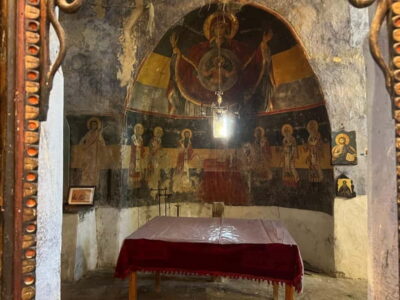
The two apses are the kind of detail that sounds technical until you are standing there. Then it becomes something you can actually see and appreciate as a design choice with religious meaning. You also get to see restored frescoes, which can change your whole understanding of the site. When painted scenes are brought back, the monastery starts to feel like a living space again, not only an artifact.
This stop also has a strong setting component, since the monastery sits in a serene area surrounded by olive groves and dramatic natural scenery. You do not need to over-romanticize it. Just take in the quiet, because it helps you slow down and absorb the guide’s talk about Orthodox heritage in southern Albania.
Admission is marked free for this stop. For me, that makes it one of the best “time per dollar” moments on the route.
Stop 5 Near Saranda: Monastery of 40 Saints Ruins and Sea Views
The final historical stop is the ruins of the Monastery of the Forty Saints, near Saranda. You are at a 6th-century Byzantine site, and the experience is built around what you can feel in the view.
You get panoramic sea views, and the guide connects the site to the origin of the city’s name. That connection is useful because it makes the ruins more than scenery. It turns them into an explanation for how place names and local identity can survive for centuries.
This stop often feels mystical in a way that is not performative. Ruins do that when the timing is right, light falls across stone, and the setting is open enough to let your imagination do its job without turning the day into a fantasy movie.
Admission is marked included for this stop. It is also the stop where the tour earns its wrap-up mood, because you are finishing with a feeling, not just a checklist.
Byrek and Dhallë at the End: What to Expect When Meals Aren’t Included
At the end, you stop at a local spot near Saranda for freshly made byrek and refreshing dhallë. This is one of those moments that makes the tour feel less like museum hopping and more like a day you could remember.
That said, meals are not listed as included. So treat this like a food stop where you can buy and try. If you have allergies or specific dietary needs, this is your cue to check ingredients before ordering. Byrek can vary by filling, and dhallë is a simple comfort food you can usually find in basic versions.
For me, this end stop is a smart payoff. You spent the day thinking about culture and community. Then you get to taste everyday Albanian life.
Price and Value: Why $59.15 Can Make Sense Here
Let’s talk money in plain terms. You pay $59.15 per person for a roughly 5-hour tour. You get transport and a guide who provides English commentary, plus multiple stops across different religious sites.
Is it a bargain? If you were paying separate taxis between rural villages and paying entry fees one by one, it would likely add up fast. Here, the biggest value is that transport is covered and several admissions are marked free or included across the route.
The tour also keeps group size small, with a maximum of 5 travelers. That means you usually get more time per stop and fewer delays. For a half-day focused on sites, that’s real value, not a marketing line.
If you are trying to do a “religious heritage and harmony” theme in Saranda, this price point is reasonable because the itinerary is active and site-based.
Who Should Book This, and Who Might Want Another Day
This tour is a great fit if you:
- Like culture that goes beyond one religion and one era
- Enjoy guided context, especially when it connects architecture to daily life
- Want a calmer alternative to big bus tours
- Are interested in Ottoman and Byzantine remnants in southern Albania
It is also a good choice if you only have a short time in Saranda and want a structured day. You cover multiple villages, and the tour timing keeps it from swallowing your whole vacation.
I would reconsider if:
- You do not handle outdoor walking well (even if the tour says most people can participate, ruins and village areas are still uneven in many places)
- You hate weather-dependent plans, since the experience requires good weather
Should You Book This Saranda Religious Sites Tour?
Yes, you should book if your travel style likes meaning tied to places. This tour works because it moves through real religious sites with a guide who explains coexistence as something shaped by history, architecture, and community life. It is also strong when you want variety in a single half-day, not just one church and a quick return.
Before you go, pack for comfort: good shoes, water, and a light layer in case the air feels cooler near open ruins. Then show up ready to listen, not just look.
If you want to leave Saranda with more than photos, this is one of the better ways to do it.
FAQ
Is pickup included, and where do I meet the group?
Pickup is offered from the arrival hall. The driver waits with a sign showing the lead traveler’s name. The meeting point is Saranda Hidden Stories on Rruga Naim Frashëri, Saranda, and the tour ends back at the meeting point.
What language is the tour offered in?
The tour is offered in English.
How long is the tour?
The tour duration is about 5 hours.
Are entry tickets included for the sites?
Admission is listed as free for some stops and included for others. Specifically, the Xhermehalla Islamic Complex in Delvinë and the stops in Finiq and Mesopotam are marked free, while the Gjin Aleksi Mosque and the Monastery of Forty Saints stop are marked as included.
Are meals included?
Meals are not included. The itinerary mentions a stop near Saranda for byrek and dhallë, but that is not listed as included in the package.
How big is the group?
This tour has a maximum of 5 travelers.
Added to Saranda lately
- Visit the city of Konispol★ 5.0 · 1 review
- Visit the Mosque of Gjin Aleksi and the Islamic Complex of Xhermehalla★ 5.0 · 1 review
- Sarandë: Destinations of North of Saranda Boat Trip★ 1.0 · 1 review
- Lekuresi Castle,Blue Eye,Ancient City of Butrint and Ksamil★ 5.0 · 1 review
- Half-Day Sightseeing Tour to Gjirokastra and Blue Eye★ 5.0 · 1 review
- Visit The Ancient City of Butrint★ 5.0 · 1 review
- Ancient Butrint and Gjirokaster Ottoman City★ 5.0 · 1 review
- Private Albanian Riviera Highlights Tour★ 5.0 · 1 review
Saranda Tours & Experiences, compared.
Lekursi Castle, Blue Eye, Gjirokaster, & More Tour
Read our review →
Daily Trip To:Blue Eye,Monastery,Gjirokaster&Lekursi Castle
Read our review →
Hidden Cave, Gremina, Kakome & Krorez Boat Tour
Read our review →
Boat Tour at Kroreza & Hidden Caves with Snorkeling
Read our review →
Group Tour 7 stops Saranda to Krorez Free Drink and Umbrella
Read our review →
Boat Tour to 7 Destinations with Beach Umbrella
Read our review →Kakome, Caves & Beaches Boat Tour with Snorkeling
Read our review →Browse the lists this tour appears in