
Reviewed · BERAT, OSUMI & BOGOVA TRIPS
Best of Berat and Durres Full Day Tour
A Roman amphitheater and icon paintings in one day? That’s exactly the mix here: Durres for Adriatic-era city layers, then Berat for hilltop streets, mosques, and famous religious art. I really like how the route balances the big, obvious sights with smaller stops that make the day feel human, like Kala’s courtyard-like streets and a slow walk through Mangalem. I also like the guide style, with people such as Llir and Iliri bringing history into everyday storytelling, so the stops connect instead of feeling like a checklist.
Still, it is a long 8 to 9 hour day, and you should plan for comfort. Bottled water is listed, but one experience I saw had a water and bathroom timing hiccup, so I suggest you ask for water and quick restroom timing right at the start, then pack a few snacks just in case. If you book in winter, remember the days are shorter, which can make a long route feel tighter.
In This Review
- Key Things to Know Before You Go
- A Long Day With Two Big Stops, Durres Then Berat
- Getting Moving From Tirana, Pickup and the Comfort Factor
- Durres Old Town: Dyrrachium Roots, Byzantine Ruins, and Roman Urban Planning
- Trajan’s Roman Amphitheater in Durrës: Big Scale, Earthquake History, and a Modern Discovery
- The Venetian Tower: A Defensive Fortress Turned Heritage Interpretation Center (2023)
- Durres Beach Promenade: The Short Break You Actually Need
- Berat Castle and Kala Quarter: White Streets Under Crumbling Walls
- Onufri Museum in the Church of the Dormition of St Mary: Icons, Paintings, and Iconostasis
- King Mosque, Halveti Tekke, and the Ottoman Side of Berat
- Mangalem Quarter: The City of 1000 Windows
- Gorica Bridge: Seven Arches, Ottoman Style, and a Few Playful Details
- Price and Value: What $142.02 Buys for 8 to 9 Hours
- Small Practical Tips That Make the Day Go Smooth
- Who This Tour Suits Best, and Who Might Want a Different Pace
- Should You Book This Durres and Berat Full-Day Tour?
- FAQ
- What time does the tour start?
- How long is the tour?
- Is pickup included, and where does it happen?
- Do you pick up outside Tirana?
- Is the tour offered in English?
- What group size should I expect?
- What’s included in the tour price?
- What’s not included?
- Which entrance tickets are included versus free?
- What if weather is poor?
- What is the cancellation window?
Key Things to Know Before You Go
- A tight 8 to 9 hour route with travel time already built in from Tirana
- Max 12 people, so you get conversation time without feeling like a crowd
- Durres highlights with UNESCO buzz, including a Roman amphitheater on the tentative list
- Berat’s icon art in context, with Onufri paintings inside the Church of the Dormition of St Mary
- Ottoman architecture plus religion, from the King Mosque to the Halveti Tekke
- A 2023 update at the Venetian Tower, now a Heritage Interpretation Center with digital tools
A few more Berat, Osumi and Bogova trips:

A Long Day With Two Big Stops, Durres Then Berat
This is the kind of tour that works best when you accept one simple truth: it is a full day, not a slow afternoon. You start in Tirana and spend the hours hopping between the ancient port city of Durres and the UNESCO-feeling hill town of Berat.
The payoff is variety. You get Greek roots turned Roman and Byzantine layers in Durres, then you move into Ottoman-era neighborhoods and church interiors in Berat. By the end, you understand why Albania’s cities look the way they do, not just what buildings exist.
Getting Moving From Tirana, Pickup and the Comfort Factor
Pickup is offered from wherever you want inside Tirana, as long as you coordinate the exact point after booking. The tour runs from 9:00 am, and travel time is included in the total duration, so you do not lose your day to extra commuting surprises.
You’ll ride in an air-conditioned vehicle with a licensed tour guide. The group size is capped at 12 travelers, which helps you keep moving without turning the day into a loud bus parade. Bottled water is included, but I still recommend you bring a small snack and keep tissues handy. Small comfort items matter on a long loop through multiple neighborhoods.
Durres Old Town: Dyrrachium Roots, Byzantine Ruins, and Roman Urban Planning
Durres starts as an ancient story. The site traces back to Ancient Greek colonists, around the 7th century BC, and later becomes part of the Roman Empire and the Byzantine world. A major reason this matters is geography: Durres is tied to Mediterranean routes, and the Via Egnatia begins here, running across the Balkans toward Constantinople.
In the Old Town area, you’ll focus on what those layers left behind: the ruins of Byzantine forum and walls, Roman-era baths, and the city center feel. There’s also time tied to the archaeological museum, which is the kind of stop that helps you connect what you see outside to what you learn about how the city worked.
One small caution: Durres is compact, but you are still in an outdoor-on-foot mix. Wear shoes you trust. If you do, you’ll enjoy how quickly you can shift your attention from sea views to stonework details.
Trajan’s Roman Amphitheater in Durrës: Big Scale, Earthquake History, and a Modern Discovery
The Roman amphitheater of Durrës is at the center of the city, and it carries an impressive backstory. Construction began under Emperor Trajan in the 2nd century AD, and later it suffered destruction from earthquakes in the 6th and 10th centuries.
It was discovered in late 1966, and today it’s the largest Roman amphitheater built in the Balkan Peninsula, once holding about 20,000 people. The site also appears on Albania’s tentative list for UNESCO World Heritage, which gives you that extra sense of why it matters beyond the local level.
The practical win: this stop is short but visually powerful. Even if you know only a few Roman terms, the sheer scale helps your brain grab the story fast. Admission is included here, so you are not juggling extra tickets mid-day.
A few more Durres beach and amphitheatre days:
- Tirana/Durres/Golem: Saranda, Ksamil, Blue Eye Day Trip
★ 4.8 · 1,584 reviews - From Tirana/Golem/Durres: Kruja, Bazaar, Sari Salltik Tour
★ 4.8 · 471 reviews - From Tirana: Durres History Trip with Beach or Promenade
★ 4.8 · 455 reviews - From Tirana/Durres: Saranda & Ksamil Beach and Gjirokastra
★ 4.9 · 428 reviews
The Venetian Tower: A Defensive Fortress Turned Heritage Interpretation Center (2023)
From the amphitheater area, you move toward one of Durres’s most striking defensive structures: the Venetian Tower. The tower connects to the older Byzantine fortress system and the western Adriatic defense needs.
The roots of the fortress effort are linked to Byzantine Emperor Anastasius I (491–518), and the present-day tower sits atop earlier Byzantine structure work, then gets reinforced and adapted around the 15th century. The Venetians fortified it further, including cannons to protect the city from the sea and a key observation role.
The modern twist is what I think you’ll like most: the Venetian Tower was renovated in 2023 and now functions as Albania’s first Heritage Interpretation Center. You explore historical events and places using digital and multimedia tools. That means you get both stone-and-view plus a more guided way to understand what you’re looking at.
Durres Beach Promenade: The Short Break You Actually Need
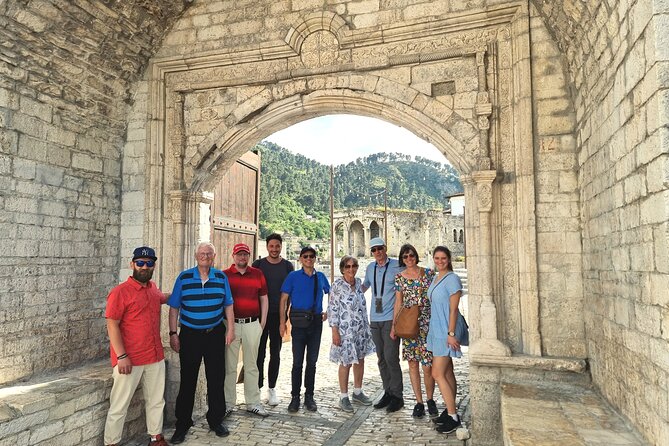
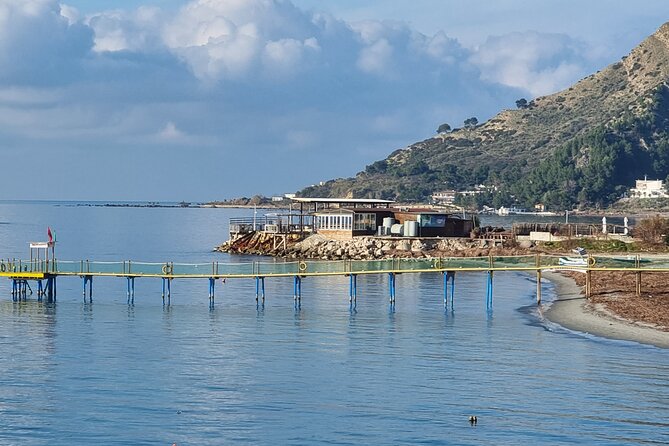
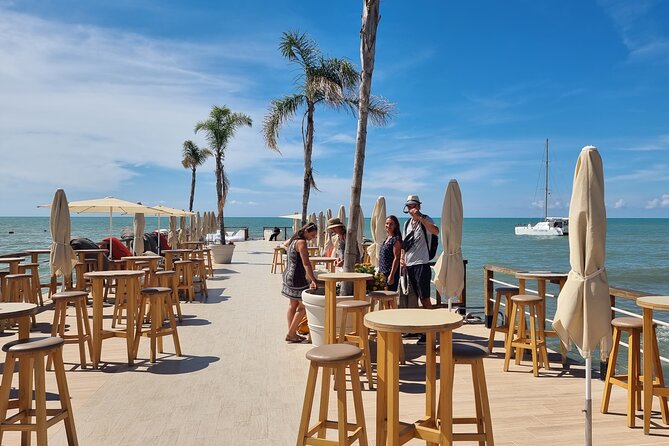
After the ancient stops, the tour adds a simple reset: time at the Durres Beach Promenade. You get about 30 minutes for a walk with Adriatic views and a chance to grab a café drink.
This is the moment to handle two things. First, check your energy level before you go inland toward Berat. Second, plan your timing for food, because meals are not included on the tour. Even if you do not eat a full lunch, consider a snack here or at a nearby stop before the hill-town walking starts.
Berat Castle and Kala Quarter: White Streets Under Crumbling Walls
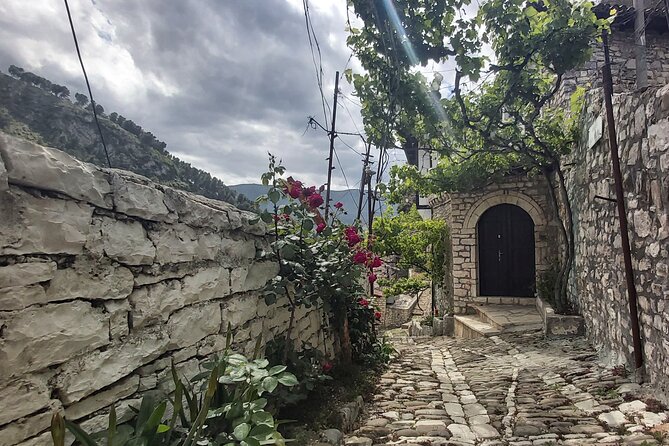
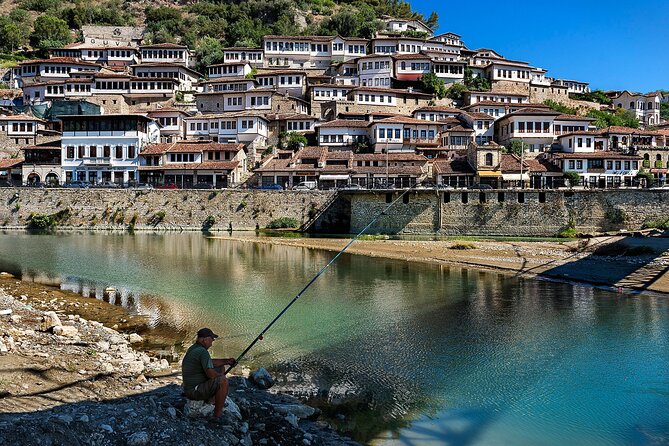
Then you’re off to Berat, where the hilltop fortress crown dominates the skyline. The castle area sits above the city, and behind the fortress walls is Kala, a village-like neighborhood made of whitewashed buildings and cobbled streets.
If you walk long enough, you’ll see courtyards and side entrances that can look like churches or ruins, even when you’re just passing someone’s private space. That’s part of the charm, and in Berat it’s not treated like a rude interruption.
This stop is about 40 minutes, with admission included. The best way to enjoy it is to slow your pace on purpose. When you rush, you miss the way the quarter folds and reveals different views of the city and the river below.
Onufri Museum in the Church of the Dormition of St Mary: Icons, Paintings, and Iconostasis
Berat’s art stop is the Onufri Museum, located inside the Church of the Dormition of St Mary. The church dates to 1797, built on foundations of an earlier 10th-century chapel. Inside, you see spectacular 16th-century religious paintings, plus a gilded 19th-century iconostasis.
The museum holds around 200 artwork objects, icons, and liturgical items spanning the 14th to 20th centuries. You’ll see icons painted by Albanian icon painters such as Onufri, Onufri’s son Nikolla, and Onufër the Cypriot.
If you care about religious art, you’ll love how this stop makes the rest of the day click. Seeing icons in the church where they were gathered helps you understand how art and faith played together in Berat over centuries. Time here is about 40 minutes, and admission is included.
King Mosque, Halveti Tekke, and the Ottoman Side of Berat
Berat’s spiritual landscape includes both mosques and dervish heritage sites, and this tour hits key examples.
First up is the King Mosque, also known as the Sultan’s Mosque (Sultan Bayezid Mosque). It was built in the 15th century by Ottoman sultan Bayezid II, later rebuilt in the 19th century to prevent collapse, and it is still an active site today. Inside, one of the highlights is a women’s gallery with intricate painted designs and decorations on its wooden ceiling. Admission is included.
Then you visit the Halveti Tekke. This is a worship space for the Helveti, Muslim dervishes or mystics. The small square building was constructed in the 15th century, then rebuilt by Ahmet Kurt Pasha in 1782. Above its doorway is an inscription dedicated to him. Inside there’s a prayer hall and an external portico with columns said to originate from Apolonia ancient city. There’s also a balcony designed to improve sound quality for religious rituals. This is shorter, around 10 minutes, with admission included.
Mangalem Quarter: The City of 1000 Windows
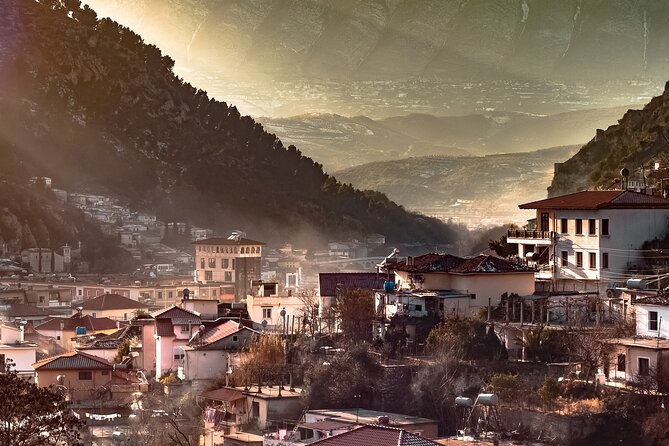
Next comes Mangalem, one of Berat’s most iconic quarters. It sits just north of the Osumi River, south of Kalaja, and it carries an Ottoman-root Islamic neighborhood feel that still shows in the architecture.
As you walk through Mangalem, you’ll see centuries-old white stone houses with terracotta tiles, wooden doors, and flowers hanging from windows. The neighborhood earns the nickname City of 1000 Windows because of the abundance of large, symmetrical windows lined across the rocky hillside.
This stop is about 30 minutes and admission is free. The best way to enjoy it is to keep your eyes moving. Look for patterns, window lines, and how the houses step with the slope. It’s one of the best places on the day for photos that actually look like Berat.
Gorica Bridge: Seven Arches, Ottoman Style, and a Few Playful Details
To finish, you head to Gorica Bridge, one of Berat’s most admired Ottoman bridges. The bridge connects the city to the Gorica neighborhood and uses a gentle, gradual arch shape.
Key details to notice: it’s about 10 meters tall, extends around 130 meters across the Osumi riverbed, and has seven arches. You’ll also see wooden railings and small window-like openings that give the arches whimsical facial features. Admission is free, and you’ll get roughly 30 minutes here.
Even if you do not usually care about bridge design, this one holds attention because it’s both functional and visually playful. It’s the kind of stop that makes the day feel like a story instead of a sequence.
Price and Value: What $142.02 Buys for 8 to 9 Hours
At $142.02 per person, the question is not whether it’s cheap. It’s whether it saves you planning headaches. And in this case, it largely does.
You get air-conditioned transport, pickup within Tirana, a licensed guide, and bottled water listed as included. You also get the structure of a full day that links Durres’s ancient port layers to Berat’s Ottoman neighborhoods and church art. For many first-time visitors, that’s where the value comes from.
It also helps that several entrances are included. In the Durres and Berat mix, you’ll have included admission for the Roman Amphitheater, Berat Castle (Kala), the Onufri Museum, the King Mosque, and Halveti Tekke. Other stops are free, like the beach promenade and the general Mangalem walk.
The main value tradeoff is meals. Meals and drinks are not included, and the day is long. I recommend you eat something before the tour starts or plan to buy a simple lunch during the break window, so you’re not tired and grumpy by the time you reach the museum and mosques.
Small Practical Tips That Make the Day Go Smooth
A few choices can make your day feel easier.
- Ask your guide early about water timing and restroom breaks. Even with bottled water listed, I saw one complaint about water not being provided and bathroom timing being limited. If you handle it up front, you avoid stress later.
- If you’re visiting in winter, be realistic. One reviewer specifically warned that shorter days can make a long itinerary harder to appreciate fully. Plan for daylight and bring a light layer you can add and remove.
- Wear shoes for mixed terrain. This isn’t one of those tours where you stay parked next to each stop. You walk, and you want your feet to thank you.
- Bring a little cash for personal needs. Tips are not included, and meals are not included, plus optional add-ons are extra.
Who This Tour Suits Best, and Who Might Want a Different Pace
This works best if you want a first taste of two very different Albanian city personalities in one day. You’ll like it if you enjoy Roman ruins, Byzantine and Ottoman architecture, and church art without needing deep museum study time for every single stop.
It’s also a good fit for couples or small groups who want a guided connection between sites. The higher ratings you’ll see linked to guides such as Llir and Iliri often mention great conversation and a relaxed feel, which is exactly what you want on a long schedule.
If you need very frequent breaks, prefer slow pacing, or dislike long transit days, you might feel rushed. This is not a short sampler. It’s a full-day arc.
Should You Book This Durres and Berat Full-Day Tour?
I’d book it if you want a single ticket solution for seeing Durres’s amphitheater scale and Berat’s iconic hilltop neighborhoods plus the Onufri art inside the Church of the Dormition. The included admissions, the cap of 12 people, and the mix of sea views, monuments, and streets make it a solid value for people who like structure.
I’d hesitate only if you know you do better with flexible pacing, or if you dislike long days with minimal meal planning. In that case, you may want a shorter Durres-only or Berat-only option so you can move at your own rhythm.
FAQ
What time does the tour start?
The tour starts at 9:00 am.
How long is the tour?
The duration is about 8 to 9 hours.
Is pickup included, and where does it happen?
Pickup is offered from anywhere inside the city of Tirana. You need to coordinate the exact pickup point after booking.
Do you pick up outside Tirana?
If you need pickup outside the city of Tirana, an extra cost applies and is paid directly to the guide using cash, PayPal, or bank.
Is the tour offered in English?
Yes, it is offered in English.
What group size should I expect?
The tour has a maximum of 12 travelers.
What’s included in the tour price?
Included items are an air-conditioned vehicle, professional drivers with deep knowledge of history, a licensed tour guide, a private tour option, and bottled water.
What’s not included?
Meals and drinks, personal expenses, tips and gratuities, and optional activity costs are not included.
Which entrance tickets are included versus free?
Some sites are free and some are included. Admission is included for the Durres Roman Amphitheater, Berat Castle (Kala), the Onufri Museum, the King Mosque, and the Halveti Tekke. Other stops like Durres Old Town, the beach promenade, Mangalem, and Gorica Bridge are listed with free admission.
What if weather is poor?
This tour requires good weather. If it’s canceled due to poor weather, you’ll be offered a different date or a full refund.
What is the cancellation window?
You can cancel up to 24 hours in advance for a full refund. If you cancel less than 24 hours before the start time, the amount you paid will not be refunded.
More Full-Day in Tirana
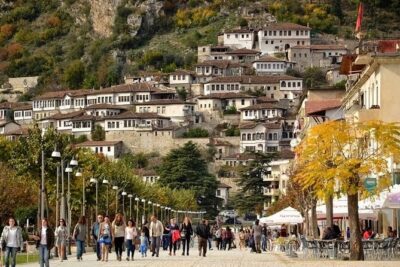
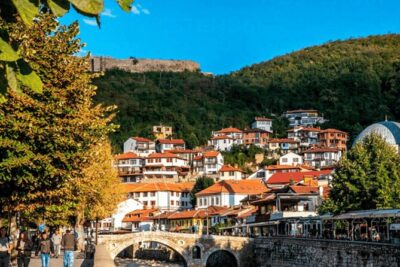
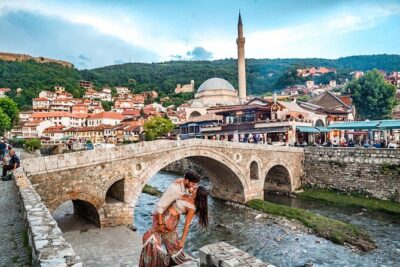
Added to Tirana lately
- Semi-Private Hiking Tour; Theth,Valbona&Koman Lake in 3 Days★ 5.0 · 1 review
- Kosovo, Prizren Day Trip from Tirana★ 3.0 · 1 review
- Private 1 Day Berat Tour from Tirana★ 5.0 · 1 review
- Private 3 Days Adventure in Albania and Gjirokaster County★ 5.0 · 1 review
- From Tirana: Ksamil Islands, Saranda, & Blue Eye Day Trip★ 5.0 · 1 review
- Tirana Airport Private Transfer To City★ 5.0 · 1 review
- Architectural Walking Tour Discovering Tirana’s Modern Identity★ 5.0 · 1 review
- From Shkoder: 3-Day Valbona to Theth Hike Tour All Inclusive★ 5.0 · 1 review
Berat, Osumi & Bogova Trips, compared.
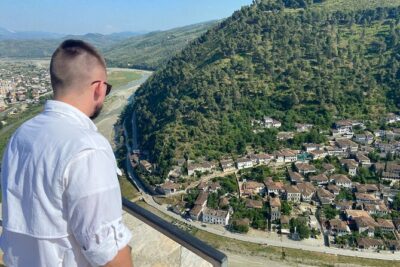
Berat city UNESCO tour, the Castle & Belshi lake- From Tirana
Read our review →
Berat Tour Osumi Canyons Exploration Lunch Transfer
Read our review →
Osumi Canyons and Bogova Waterfall from Berat – Tour by 1001 Albanian Adventures
Read our review →Browse the lists this tour appears in